News
Friends of our project will know that there are no known drawings, images or plans of the original Teatro San Cassiano of 1637. Well, the same goes for its exterior; not only for 1637, but throughout its lifetime through to its final destruction in 1812.

One source available is that of the early “tourist-maps” of Venice, though the evidence they offer is limited and certainly not wholly reliable. They were neither maps as we would use them today nor engraved with the intention of documenting our theatre. The maps are consequentially problematic, leaving us unable to be certain that we have identified the theatre, or if it has been depicted at all; worse still, as the theatre was not the motive for the engraving, the image itself lacks sufficient detail to be considered a wholly faithful depiction. This is the case with this map from the late seventeenth century (from a collection of Joan Blaeu prints, but attributable to Pieter Mortier, c.1690) where we tentatively suggest identify our theatre, or at least where it should be.
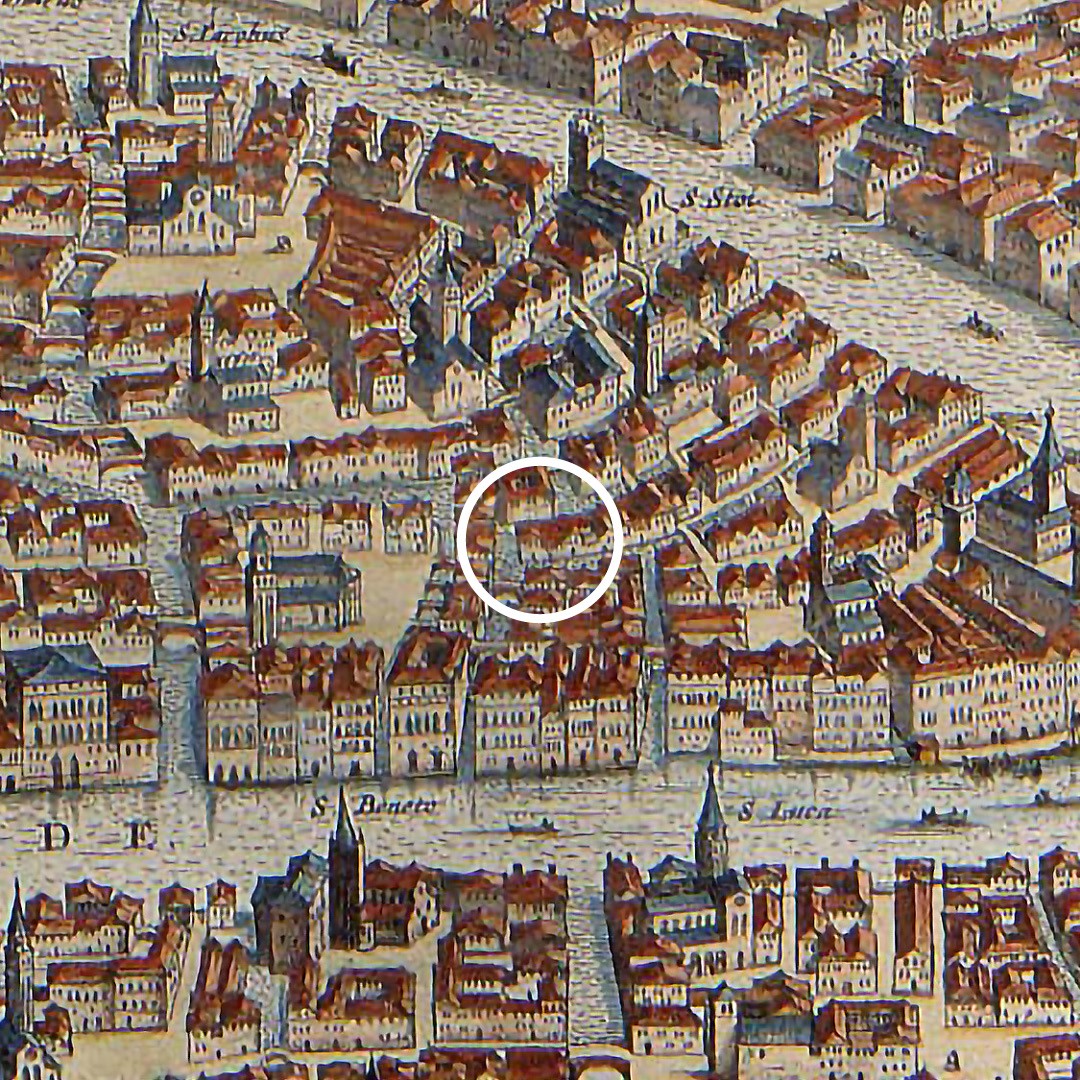
But all is not lost. The lack of distinct detail is also not without significance. Here, the image we see supports our understanding that at this time the exterior of theatres had not yet acquired the need for grandiosity or statement, which would follow. Thus, there is no reason not to accept its consistent portrayal in these maps as lacking particularly distinguishable features compared to its neighbours.
We might think it extraordinary that at no point has its notoriety been sufficient for someone to draw or paint it. After all, one of the most important drawings for the Shakespeare’s Globe project was this wonderful image of the second Globe, built in 1614 (noting it was misnamed in the image).

But, perhaps when we put both images together, the clue is in the difference between the two? ), Excepting of course their different circumstances, the Globe was a stand-alone theatre with a very distinctive shape, tied directly to its very being. The San Cassiano was not. Its exterior was a container in which to house the theatre, as was common with many Venetian theatres of the time. From the very limited evidence available, we know nothing of its exterior, which might distinguish it in the way we note of the Globe, and perhaps it is thus this lack of identifiable detail which in and of itself might explain the lack of imagery? We simply do not know, but of course we ought always to remember that in Venice the artist’s eye would have been drawn to all too many greater opportunities.
This leaves us only with a series of maps, none of which sufficiently target the San Cassiano to give us any great insight compared to the detail of Jacopo de’ Barbari’s map of 1500, sadly long before the original Teatro Tron of 1581.

But again, all is not lost. If we compare the theatre site pre its existence under de’ Barbari and then during its lifetime under Mortier, a sharp eye will note that the building has grown in height. Does this, then, record the building of the Teatro Tron (and thus of the San Cassiano)? As always, the evidence is far too weak for certainty, but the images do comply with the known narrative and sufficiently so to keep us amused and entertained. Of course, the logical conclusion of this article is to now invite anyone out there to go one step further and provide a better image of the San Cassiano’s exterior.
To finish, we have one more treat, an architect’s drawing (Francesco Bognolo?) of the San Cassiano façade from c. 1763, for which our understanding is that it was never realised; however, from which we can see that the need for grandiosity and statement had by now arrived!

As we have said so many times, both the fun and, indeed, the value of this project is learning to embrace the fact that in some areas we do not yet know what we do not know; and while we have only just begun, increasingly we find new light is being shone onto an increasing range of interdisciplinary aspects about the theatre, its life and its impact. Our great advantage is that to our knowledge we are the first to try and rebuild this beautiful theatre, and that does change our perspective in so many ways. So, while we make no claim here of any great find (it remains too early for that), we do believe this is just one example of the type of conversations that can start once we stop and take a look at just what evidence really lies there waiting our attention. Here, for example, we are not aware of anyone having previously identified the Teatro San Cassiano as we have now tried to do. It’s going to be fun. We hope you enjoy these images.